


New UAE E-Invoicing Functionality in FirstBit ERP: Release Scheduled for Q4 2026
Publication date 12 Nov 2026
•
1 min read

Anna Sharygina
Content Writer


The transition to e-invoicing in the UAE requires businesses to prepare their accounting processes in advance, choose a connection method, sign an agreement with an Accredited Service Provider (ASP), and complete the onboarding process.
To simplify the transition to e-invoicing and integrate electronic invoice processing into everyday accounting workflows, we are developing new functionality for FirstBit ERP and FirstBit Accounting in line with the latest UAE electronic invoicing requirements. The update is scheduled for release in
Q4 2026.
Q4 2026.
In this article, we will share what is currently known about the upcoming release, outline the steps companies need to take to connect to the e-invoicing system, and explain how FirstBit ERP and FirstBit Accounting users can prepare for the transition.
What First Bit Customers Need to Know
To transition to e-invoicing, companies in the UAE will need to complete several steps. The general implementation roadmap includes:
- Verifying registration on the FTA portal. Companies need to ensure that their registration details are up to date. The TIN associated with their registration will subsequently serve as the basis for their Peppol ID.
- Selecting and appointing an Accredited Service Provider (ASP). Businesses need to choose a provider for electronic document exchange. First Bit has already selected Flick Network and TronStride as its ASP partners, enabling customers to connect on favorable terms.
- Obtaining a Peppol ID. Once an ASP has been appointed, the company receives an identifier for operating within the Peppol network.
- Choosing an e-invoicing processing method. At this stage, the company selects the most suitable approach: integration with an ERP or accounting system, manual data entry, or file uploads.
- Testing electronic document exchange. Before going live, it is essential to verify how electronic invoices are generated, sent, and received.
- Going live. Once testing is complete, the company can begin using e-invoicing in its daily operations.
How Electronic Invoice Exchange Will Work
The UAE plans to use the Decentralized Continuous Transaction Control and Exchange (DCTCE) model for electronic invoicing. This model is based on Peppol's five-corner approach, in which electronic invoices are exchanged through Accredited Service Providers (ASPs) and the Peppol infrastructure.
For FirstBit ERP and FirstBit Accounting users, this means that the upcoming functionality will be designed to support the electronic document exchange model adopted in the UAE.

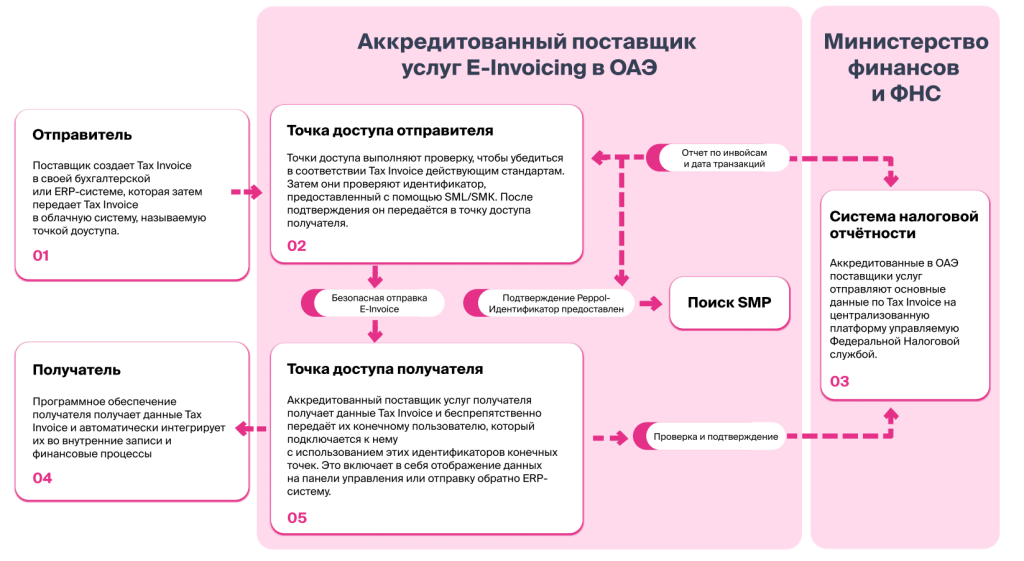
DCTCE Model / Five-Corner Model
What This Means for FirstBit ERP and FirstBit Accounting Users
The planned release will help FirstBit ERP and FirstBit Accounting users prepare for the UAE's e-invoicing requirements and integrate electronic invoice processing into their existing accounting workflows.
We are continuing to develop the new functionality and have already signed agreements with Flick Network and Transtek as our ASP partners. These partnerships will allow First Bit customers to benefit from favorable connection terms.
On August 1, our customers will receive step-by-step instructions on connecting to the e-invoicing system and preparing their accounting software for the new requirements.
If you have any questions about e-invoicing capabilities or the terms of cooperation with ASPs, please submit an inquiry through our Contact Us page, and our specialists will get in touch to provide a consultation.
We will explain how FirstBit ERP and FirstBit Accounting can help your company prepare for the new requirements and ensure a timely transition to e-invoicing.

Anna Sharygina
Content Writer
Share this article



Book a demo online or at your office
We'll show you how 1C can meet your business needs and help you find the right solution during a personalized demo.